When the argument is over but the silence goes on, there are small ways to reach across it without having to apologize first.
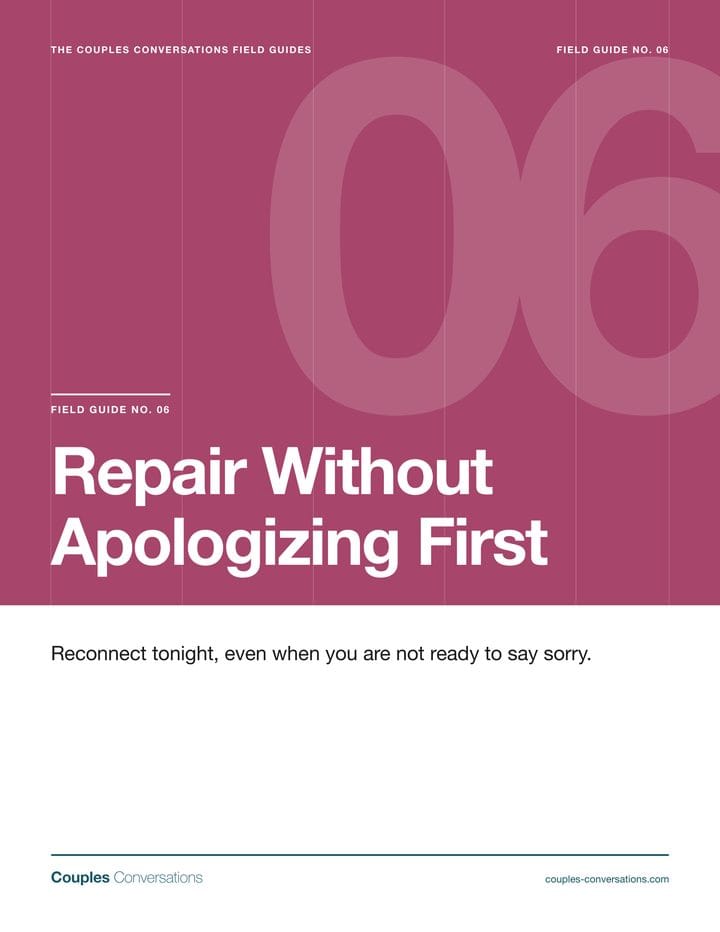
Ten ways to reconnect after a fight, ranging from a small gesture that costs very little to fully reopening the conversation, so you can choose the step that feels possible on a given night. From Dr. Ari Sytner, PhD, LCSW, Certified Gottman Therapist.
Instant download. If this doesn’t give you something you can use in your next conversation, reply and you’ll get a refund.
Consider a couple two hours after an argument. One partner is in the kitchen and the other is in the next room, and the house has gone quiet in a way that can feel worse than the shouting did. Each of them has replayed the fight enough to suspect they were partly wrong and mostly right, and neither is willing to walk into the other room and apologize for something they still believe.
Both of them wait for the other to move first, and the longer the silence lasts, the harder it becomes for either of them to break it.
Often the way out is smaller than an apology. The idea is connection before correction: the apology can wait until both partners are calm enough to think clearly, but the silence needs a small step toward each other first, one that shows the relationship matters more than the fight without settling who was right. Dr. John Gottman calls moves like these repair attempts, any word or gesture that lowers the tension. His research found that the ability to make and receive them is one of the strongest signs that a relationship will last.
Reaching out first can feel risky, because it means moving toward a partner who may still be upset. This guide gives you ten ways to do it, arranged from the smallest to the most complete, along with words for the partner on the receiving end, because a repair only works when it can be received.
What’s inside
- Why reaching out is not giving in. Why a repair is not the same as conceding, and why a long silence can make it harder for both of you to come back together.
- The Repair Menu, ten repair attempts arranged from a small gesture to a full reopening of the conversation, so you can choose the step that fits how you are feeling.
- How to receive a repair, with words for the partner on the other side, so a small step toward each other is easier to recognize and accept.
- When to reach out, including how to tell whether either of you is still too flooded for a repair to be heard.
- Your Repair Menu, a one-page worksheet where you build a list of the repairs that work for your partner, in your words, before you need them.
- A composite example of a couple in the hours after a fight, including the repair that bounces off and the one that lands.
- A one-page cheat sheet and one PDF that reads on a screen and prints clean at home.
Look inside
12-page PDF · fillable worksheet · fridge cheat sheet

All 12 pages are shown here small and blurred, so the guide is yours to read for the first time when it arrives. It downloads as a PDF right after you order.
The clinician behind Couples Conversations
Couples Conversations is the work of Dr. Ari Sytner, PhD, LCSW, a Certified Gottman Therapist, clinical professor at Yeshiva University’s Wurzweiler School of Social Work, and author of the Couples Conversations™ book series. For many years he has worked with couples in therapy, and the Field Guides were created to answer a question that often follows a helpful article: “Okay, but what do I actually say?”
Each guide names the research it draws on and stays within what that research supports. The scripts are written in the plain, everyday words couples use with each other, so they feel natural to say. Each guide also picks up where its article leaves off, so that the ideas you may have read about become words you can use at home.
Built on Dr. John Gottman’s research on repair attempts, the small words and gestures that lower the tension and keep a fight from doing lasting damage, and on his work on flooding, the state in which even a well-made repair is hard to hear. Each source is named in the guide at the point where it is used.
Repair Without Apologizing First

A simple guarantee
If this doesn’t give you something you can use in your next conversation, reply and you’ll get a refund.
There is no form to fill out, and no one will ask you to explain why. Because the guide is an instant download, you can read it right away and decide for yourself whether it helps.
Questions
Is this just the free article?
No. The article explains why connection has to come before correction and outlines the basic shape of a repair. The guide is the full menu, with ten graded repairs and the words for each, how to receive a repair, the worksheet, a worked example and the cheat sheet. If the article already helped the two of you reconnect, you may not need the guide, and that is perfectly fine.
Isn’t reaching out first just letting them win?
No, and the guide spends its first page on why. A repair does not have to apologize for anything or admit that you were wrong, and what it shows your partner is that the relationship matters more to you than winning the argument.
What if my partner ignores the repair?
Sometimes that means they are still flooded, and the guide covers that moment, including how to tell, how long to wait and which step on the menu to try next. It also includes words for receiving a repair, which you can share with your partner at a calmer time so that the next attempt is easier to recognize.
How long is it, and when do I get it?
The guide is twelve designed pages and takes about twenty minutes to read. The download link appears as soon as you pay, and a copy is sent to your email so you can find it again later.
What if it doesn’t help?
Reply to the delivery email and you will get a refund. You do not need to fill out a form or explain why.
Repair Without Apologizing First
Get the guide for $7If now is not the right time for the full guide, we can send you the free one-page version, with the main idea and three lines to try, so you can come back for the rest when you are ready.