When one partner checks the other’s phone, the relief rarely lasts, and the partner being checked can start to feel like a suspect in their own home.
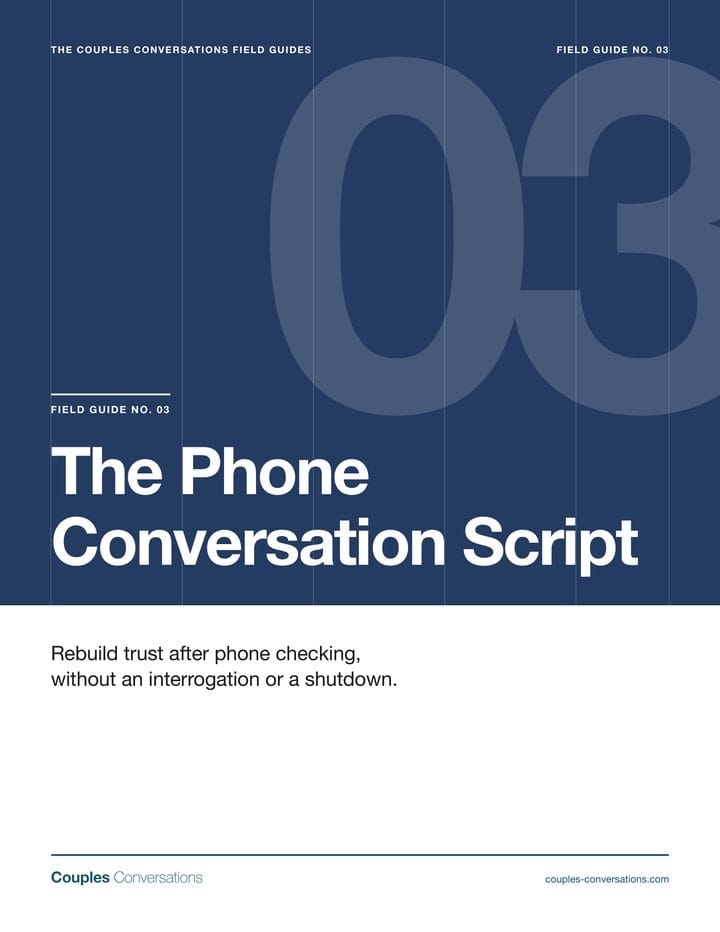
A practical guide to the conversation underneath the phone, for whichever side of it you are on, so that the real question, “Are we okay?”, can be asked and answered directly. From Dr. Ari Sytner, PhD, LCSW, Certified Gottman Therapist.
Instant download. If this doesn’t give you something you can use in your next conversation, reply and you’ll get a refund.
Some partners know the other’s passcode because it was shared freely years ago. Late one night, with their spouse asleep, they tell themselves they will not look, and then they do, scrolling through messages and photos with their heart racing. They find nothing, and the relief lasts about a minute before a new worry arrives, that perhaps they did not look carefully enough.
The partner whose phone was checked often goes through something just as painful. Finding out can feel like being watched by someone who has already decided to expect the worst. If they change the passcode, it looks as though they are hiding something, and if they leave it alone, the checking continues.
Both partners are reacting to something real, and both are stuck. Checking a phone is often a way of quieting an alarm rather than gathering information, which is why it calms the worry for a moment before the worry returns, and over time the checking itself becomes a habit.
Underneath all of the checking is usually one simple question about whether the two of you are okay. This guide gives the partner who worries the words to ask that question directly, gives the partner who was checked the words to answer it without feeling policed, and offers a simple agreement the two of you can make together.
What’s inside
- What the checking is really about. Why checking is a search for reassurance that tends to backfire, and why the partner who was checked has good reason to be hurt as well.
- Say This, Not That scripts for the anxious partner: how to ask for reassurance directly instead of going looking for it.
- Scripts for the checked partner: how to offer openness in a way that calms the alarm without agreeing to live under surveillance.
- The trust agreement, a short agreement the two of you make together, so that openness is something freely offered rather than demanded.
- The Reassurance Audit, a one-page worksheet that sorts what calms the alarm from what feeds it, done separately and then compared.
- A composite example of a couple having the conversation, including the moment one of them gets defensive and how they come back from it.
- A one-page cheat sheet and one PDF that reads on a screen and prints clean at home.
Look inside
12-page PDF · fillable worksheet · fridge cheat sheet

All 12 pages are shown here small and blurred, so the guide is yours to read for the first time when it arrives. It downloads as a PDF right after you order.
The clinician behind Couples Conversations
Couples Conversations is the work of Dr. Ari Sytner, PhD, LCSW, a Certified Gottman Therapist, clinical professor at Yeshiva University’s Wurzweiler School of Social Work, and author of the Couples Conversations™ book series. For many years he has worked with couples in therapy, and the Field Guides were created to answer a question that often follows a helpful article: “Okay, but what do I actually say?”
Each guide names the research it draws on and stays within what that research supports. The scripts are written in the plain, everyday words couples use with each other, so they feel natural to say. Each guide also picks up where its article leaves off, so that the ideas you may have read about become words you can use at home.
Built on the attachment research of Dr. Cindy Hazan and Dr. Phillip Shaver, which showed that adult romantic love runs on the same attachment system as the bonds of early childhood, and on Dr. John Gottman’s work on trust and bids for connection. The difference between openness that is offered and checking that is demanded is taught as a practical matter rather than tied to a single study. Each source is named in the guide at the point where it is used.
The Phone Conversation Script
A simple guarantee
If this doesn’t give you something you can use in your next conversation, reply and you’ll get a refund.
There is no form to fill out, and no one will ask you to explain why. Because the guide is an instant download, you can read it right away and decide for yourself whether it helps.
Questions
Is this just the free article?
No. The article explains what the checking is often trying to say. The guide is the conversation itself, with scripts for each partner, the trust agreement, the Reassurance Audit, a worked example and the cheat sheet. If the article already settled things for you, you may not need the guide, and that is perfectly fine.
Which partner is this for?
Either of you, and ideally both. Half of the scripts are written for the partner who checks and half for the partner who was checked, and the trust agreement works best with both voices in it. You can read the guide on your own and bring one page to your partner when the time feels right.
What if there was actually something on the phone?
Then the alarm was pointing to something real, and that calls for a different conversation. This guide is meant for couples where the checking has become a pattern and nothing is being found. If there has been an affair, the First 90 Days guide can help with the earliest stretch, and a trained couples therapist is the most important next step.
How long is it, and when do I get it?
The guide is twelve designed pages and takes about twenty minutes to read. The download link appears as soon as you pay, and a copy is sent to your email so you can find it again later.
What if it doesn’t help?
Reply to the delivery email and you will get a refund. You do not need to fill out a form or explain why.
The Phone Conversation Script
Get the guide for $7If now is not the right time for the full guide, we can send you the free one-page version, with the main idea and three lines to try, so you can come back for the rest when you are ready.