One partner keeps asking, the other stops answering, and both are left wondering why the same pattern keeps repeating.
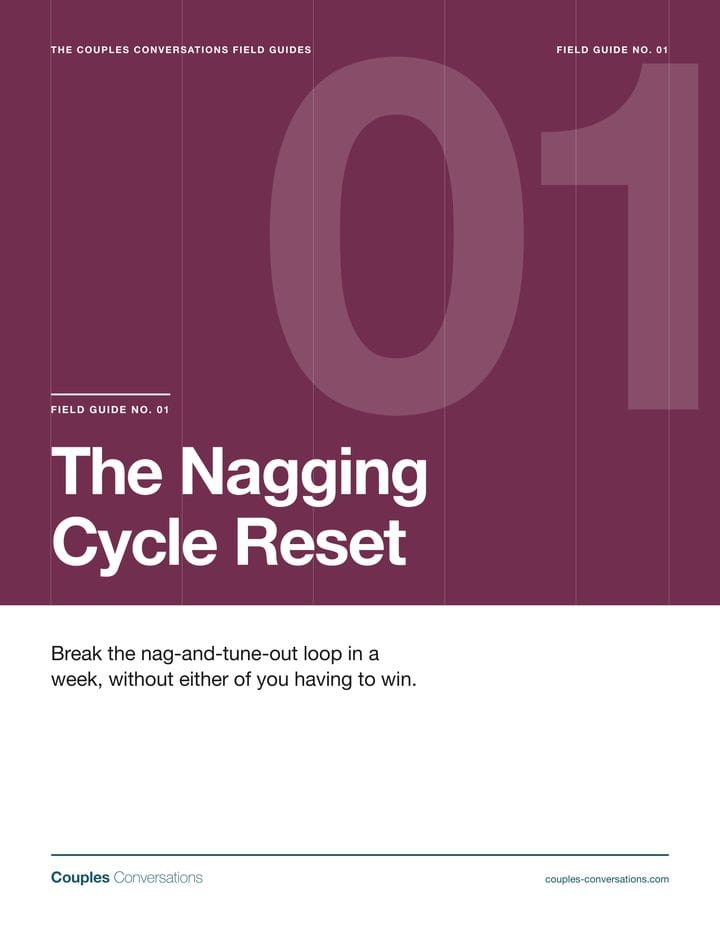
A practical guide to the nagging cycle, with words for the partner who keeps asking and the partner who has gone quiet, so that either of you can step out of the loop without anyone having to win. From Dr. Ari Sytner, PhD, LCSW, Certified Gottman Therapist.
Instant download. If this doesn’t give you something you can use in your next conversation, reply and you’ll get a refund.
In many homes, the nagging cycle begins with something small. One partner mentions the garage on Sunday and again on Wednesday, a little shorter this time, and by Friday they can hear their own voice growing sharp and do not like the sound of it. The “yep” that comes back has gone flat, the way it does when someone has stopped listening and is waiting for the conversation to be over.
The partner on the other side often lives through the same week very differently. Each reminder can start to feel like a grade on how they are doing, and when they remember doing the task last time without anyone seeming to notice, answering begins to feel pointless. Over time, many people in that position stop responding at all, because every response only seemed to bring one more request.
Neither partner intends harm, yet both feel misunderstood. Dr. Sue Johnson described this pattern as a cycle of pursuit and withdrawal. The more one partner presses to be heard, the more the other pulls back to avoid feeling criticized, and the more they pull back, the more alone the first partner feels. The reminders are often a request for connection, and the tuning out is often an attempt to lower the tension, even though from the outside it can look like not caring.
The good news is that the cycle can be interrupted from either side, and it does not take one big talk to do it. This guide gives each partner their own words, a short line either of you can use in the middle of the loop before it goes another round, and a simple worksheet that helps both of you see what the reminders have really been asking for.
What’s inside
- Why the loop keeps running. A clear explanation of how reminding and tuning out feed each other, and why it helps to treat the pattern, rather than either person, as the problem.
- The Bid Decoder, a two-column worksheet that helps both of you see the request underneath each reminder.
- Say This, Not That scripts for the partner who keeps asking, so that a request can be heard as a request rather than as criticism.
- Scripts for the partner who has gone quiet, so that an answer can reach the need underneath the reminder.
- A short line to pause the loop that either of you can use when you notice the two of you slipping into the same pattern.
- A composite example of a couple working through the reset over one week of small steps, including the night it does not go well.
- A one-page cheat sheet for the fridge, and one PDF that reads on a screen and prints clean.
Look inside
12-page PDF · fillable worksheet · fridge cheat sheet

All 12 pages are shown here small and blurred, so the guide is yours to read for the first time when it arrives. It downloads as a PDF right after you order.
The clinician behind Couples Conversations
Couples Conversations is the work of Dr. Ari Sytner, PhD, LCSW, a Certified Gottman Therapist, clinical professor at Yeshiva University’s Wurzweiler School of Social Work, and author of the Couples Conversations™ book series. For many years he has worked with couples in therapy, and the Field Guides were created to answer a question that often follows a helpful article: “Okay, but what do I actually say?”
Each guide names the research it draws on and stays within what that research supports. The scripts are written in the plain, everyday words couples use with each other, so they feel natural to say. Each guide also picks up where its article leaves off, so that the ideas you may have read about become words you can use at home.
Built on Dr. Sue Johnson’s work on the pursue and withdraw cycle, Dr. Andrew Christensen and Dr. Christopher Heavey’s research on the demand and withdraw pattern, and Dr. John Gottman’s research on bids for connection and on how the way a conversation begins shapes how it ends. Each source is named in the guide at the point where it is used.
The Nagging Cycle Reset
A simple guarantee
If this doesn’t give you something you can use in your next conversation, reply and you’ll get a refund.
There is no form to fill out, and no one will ask you to explain why. Because the guide is an instant download, you can read it right away and decide for yourself whether it helps.
Questions
Is this just the free article?
No. The article explains the cycle and why the usual responses on both sides tend to keep it going. The guide picks up from there with the words themselves, including scripts for each partner, the Bid Decoder worksheet, a worked example and the cheat sheet. If the article already gave you what you needed, you may not need the guide, and that is perfectly fine.
Which of us is this written for?
Both of you. Half of the scripts are written for the partner who keeps asking and half for the partner who has gone quiet, and the line that pauses the loop works from either side. You can use the guide on your own, and it is written so that you can share it with your partner without it feeling like one more reminder.
Will this just teach me to ask more nicely?
No. The guide focuses on the need underneath the reminders, and the Bid Decoder is designed to help both of you see what each one was asking for, which is often about more than the task itself.
How long is it, and when do I get it?
The guide is twelve designed pages and takes about twenty minutes to read. The download link appears as soon as you pay, and a copy is sent to your email so you can find it again later.
What if it doesn’t help?
Reply to the delivery email and you will get a refund. You do not need to fill out a form or explain why.
The Nagging Cycle Reset
Get the guide for $7If now is not the right time for the full guide, we can send you the free one-page version, with the main idea and three lines to try, so you can come back for the rest when you are ready.