When a small question sets off a big reaction, there are words that can keep one hard moment from taking over the whole night.
A practical guide for the moment a partner overreacts, or you do, with a way to ask for a break that does not feel like leaving, a response that calms rather than escalates, and a way to come back together afterward. From Dr. Ari Sytner, PhD, LCSW, Certified Gottman Therapist.
Instant download. If this doesn’t give you something you can use in your next conversation, reply and you’ll get a refund.
Often it begins with a small, ordinary question, such as whether anyone remembered to call the plumber. What comes back is far larger than the question, and the partner who asked is left with their own heart racing, unsure whether to defend themselves or go quiet.
The partner who reacted usually did not decide to respond that way. Something in the question may have pressed on a sore spot they did not even know was there, and by the time they could think clearly, the words were already out, and both partners were left hurting.
Dr. Sytner often compares this to an oversensitive smoke detector. If a detector is set too sensitively, burnt toast triggers the same alarm as a house fire, and in a relationship, a tone of voice or a small question can set off a reaction far larger than the moment calls for. Understanding this does not excuse harmful behavior, but it can reduce shame and increase compassion on both sides, and it makes the alarm something the two of you can learn to see coming.
This guide gives you words for the moment itself, including a way to ask for a break that makes clear you are coming back, a response that does not add fuel, and a way to return to the conversation afterward. It also includes a map of each partner’s own early warning signs, so that next time both of you can notice the alarm before it goes off.
What’s inside
- Why an overreaction is an alarm. Why a big reaction is usually an alarm rather than an attack, and why defending yourself tends to add fuel.
- How to ask for a break in a way your partner can hear as a pause rather than as leaving.
- Say This, Not That scripts for responding to a flooded partner without escalating, and for asking for the pause when you are the one flooding.
- Coming back after the break, so the pause helps the two of you reconnect instead of feeling like a retreat.
- Your Early-Warning Map, a one-page worksheet where each partner writes down their own early signs of flooding, in the body and in the words that start to come out, so both of you can call a pause sooner.
- A composite example of a couple in the ten minutes after a blowup, including the break that gets refused and how they recover.
- A one-page cheat sheet and one PDF that reads on a screen and prints clean at home.
Look inside
12-page PDF · fillable worksheet · fridge cheat sheet

All 12 pages are shown here small and blurred, so the guide is yours to read for the first time when it arrives. It downloads as a PDF right after you order.
The clinician behind Couples Conversations
Couples Conversations is the work of Dr. Ari Sytner, PhD, LCSW, a Certified Gottman Therapist, clinical professor at Yeshiva University’s Wurzweiler School of Social Work, and author of the Couples Conversations™ book series. For many years he has worked with couples in therapy, and the Field Guides were created to answer a question that often follows a helpful article: “Okay, but what do I actually say?”
Each guide names the research it draws on and stays within what that research supports. The scripts are written in the plain, everyday words couples use with each other, so they feel natural to say. Each guide also picks up where its article leaves off, so that the ideas you may have read about become words you can use at home.
Built on Dr. John Gottman’s research on flooding, the state of physical overwhelm in conflict, often around 100 beats a minute, in which nobody can listen, and on psychiatrist Randolph Nesse’s smoke detector principle, the idea that an alarm built to protect you is set to fire too often rather than miss a real fire. Each source is named in the guide at the point where it is used.
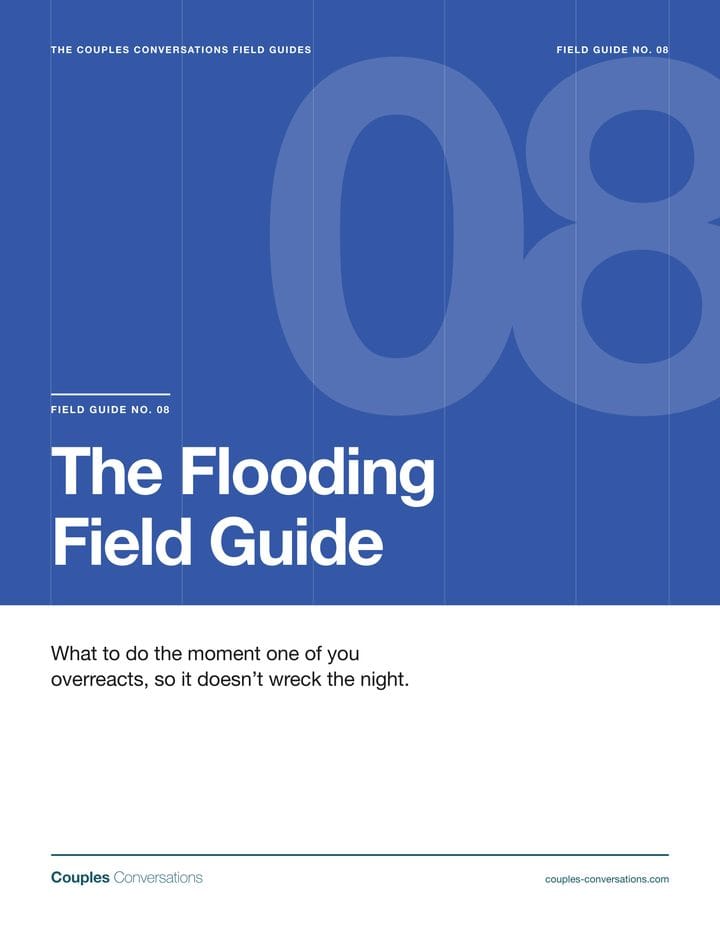
The Flooding Field Guide
A simple guarantee
If this doesn’t give you something you can use in your next conversation, reply and you’ll get a refund.
There is no form to fill out, and no one will ask you to explain why. Because the guide is an instant download, you can read it right away and decide for yourself whether it helps.
Questions
Is this just the free article?
No. The article explains why a partner may overreact and why defensiveness tends to feed it. The guide is the words for the moment itself, with the break request, a calmer way to respond, how to come back afterward, the Early-Warning Map, a worked example and the cheat sheet. If the article already helped the two of you with this pattern, you may not need the guide, and that is perfectly fine.
Isn’t this just making excuses for their behavior?
No. The guide is clear that understanding an alarm is not the same as accepting how it goes off, and it gives you words to say so without escalating. It also gives the partner who floods their own scripts, because calling a pause is their responsibility too.
What if I ask for a break and my partner follows me?
The guide covers that situation, because it happens often. A break that sounds like leaving tends to get chased, and the guide shows how to ask for one in a way your partner can trust, so that over time a pause stops feeling like abandonment. If a partner ever blocks the way or the following feels frightening, that is a safety concern rather than a communication problem, and the note at the bottom of this page applies.
How long is it, and when do I get it?
The guide is twelve designed pages and takes about twenty minutes to read. The download link appears as soon as you pay, and a copy is sent to your email so you can find it again later. The cheat sheet is a single page you can save to your phone, so it is close at hand in the moment you need it.
What if it doesn’t help?
Reply to the delivery email and you will get a refund. You do not need to fill out a form or explain why.
The Flooding Field Guide
Get the guide for $7If now is not the right time for the full guide, we can send you the free one-page version, with the main idea and three lines to try, so you can come back for the rest when you are ready.